
John Barleycorn, meteor showers and an elephant-headed god
August is named after the Roman ruler, Augustus (meaning revered) Caesar, Julius Caesar’s nephew and heir. Augustus Caesar expanded the Roman Empire by conquering Spain and a large swath of Africa. He established a police force and a fire department in Rome, built a large network of roads throughout the empire and a messaging service that was a precursor to a postal system. He reigned for 41 years and died at the ripe old age of 75. His wife Livia was said to have poisoned him.
In August sky watchers may be able to glimpse Mercury just before sunrise. A solar eclipse on August 12 can be viewed over the Arctic Ocean, Greenland, Iceland, Portugal and northern Spain. It’s likely you’ll be able to see up to 30 meteors an hour when the Perseid Meteor shower peaks the nights of August 12 and 13. The full Corn Moon rises August 28. Folks living in the Northern Hemisphere will be able to see a partial lunar eclipse that night.
On August 1, the people of the Caribbean Islands celebrate Emancipation Day, the day Great Britain officially ended the slave trade in 1834.
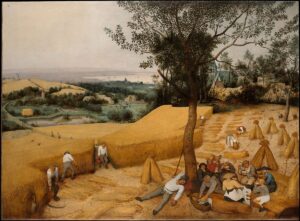
In Ireland, August begins with a festival called Lammas or Lughnasah to celebrate the Celtic sun god, Lugh. His spirit inhabits the growing grain. Once the grain is harvested, it feeds humankind and their animals. The festival celebrates once more the pattern of death and resurrection.
Lammas is a cross-quarter day, falling halfway between the summer solstice and the fall equinox. It is the first of the harvest festivals. In Great Britain, the first grains of the season were baked in a loaf and brought to church for a special blessing, called “loaf mass.” Every member of the household was to take a bite of the blessed bread for good luck, health and prosperity in the coming year.
The first harvest is celebrated in the English folksong, John Barleycorn. The song originated in the Elizabethan era and is still sung today.
There came three men from out of the West,
Their fortune for to try
As they had sworn a solemn oath,
John Barleycorn should die
They ploughed, they sowed, they harrowed him in,
Throwed clods upon his head.
And these three men made a solemn vow,
John Barleycorn was dead.
Then they let him lie for a very long time
Till the rain from heaven did fall. Then little John sprung up his head,
And soon amazed them all.
They let him stand till midsummer
Till he looked both pale and wan,
And little Sir John he growed a long beard
And so became a man.
They hired men with scythes so sharp
To cut him off at the knee
They rolled him and tied him by the waist,
and served him barbarously…
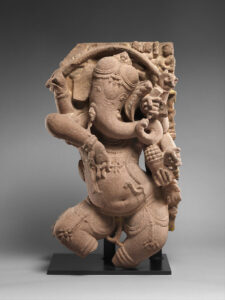
Many denominations of Hindus, Buddhists and Jains celebrate the elephant-headed god Ganesha during the month of August. Ganesha has several creation stories. One says that he was created by the goddess Parvati from clay moistened with her sweat. With his beautiful face and four arms, he looked like every other Hindu god. Unfortunately, he crossed the great god, Shiva, who decapitated him. Parvati was so furious with Shiva, she barred him from her bed chamber. Shiva relented and promised her that he would restore Ganesha’s head with the head of the next animal who happened by. And that’s how Ganesha became the elephant-headed god. He’s the god of new beginnings, of arts and letters, and of good fortune. Make an altar for him and offer him a bowl of sweets or red flowers. His prayer is: Om Shri Ganeshaya Namah.
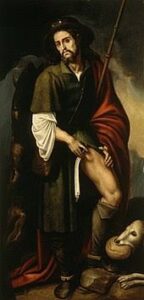
In saint-lore, we honor St. Rock on August 16. Born in France, Rock gave his inheritance to the poor and set out on a pilgrimage to Rome. The year was 1348 and the Black Plague raged over western Europe. Rock nursed the sick, and many miraculously recovered. Eventually Rock caught the plague and crawled off into a nearby wood to die. A dog happened by, licked his wounds and brought him food. Rock recovered. When he returned to France, no one recognized him. He was jailed as a spy. Only at his death in 1378, did his jailers discover his cross-shaped birthmark that identified him as the miraculous pilgrim who saved lives. His canonization was fast-tracked because another wave of plague hit France. The devoted prayed to him and the plague was lifted. Rock’s statues and paintings populate churches across western Europe. He’s portrayed in his traveling garb, lifting the hem of his tunic to expose a well-muscled thigh in a pose both pious and flirty. He’s become the patron saint of bad knees.
St. Bartholomew’s feast day falls on August 24th. He died by being skinned alive. He’s the patron saint of butchers, leatherworkers and bookbinders.
If Bartlemas Day be fine and clear
You may hope for a prosperous Autumn that year.
And—
All the tears St Swithin can cry
St. Barthelmy’s mantle can wipe dry.
—If that makes no sense to you, see my almanac for July.
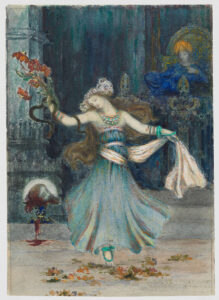
John the Baptist was beheaded at the request of King Herod’s niece, Salome, after she danced for him at his birthday feast. This leads us to Philip Stubbes, a culture critic of 16th century England, in his The Anatomy of Abuses, 1573:
All mixed, effeminate, lascivious, amorous dancing is utterly unlawful to Christians, to chaste and sober persons. For if Herod with but seeing Salome dance was so inflamed by her love, that he promised to give her whatsoever she desired…what would he have promised, had he danced with her? And I have heard many impudently say, that they have chosen their Wives, and Wives their Husbands, by dancing. Which plainly proves the Wickedness of it.
With that admonishment we turn to writing—
Born August 1, 1819 Herman Melville (Moby Dick) wrote: Of all the preposterous assumptions of humanity over humanity, nothing exceeds most of the criticism made on the habits of the poor by the well-housed, well-warmed, and well-fed.
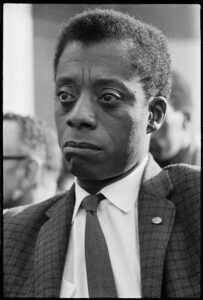
The renowned writer and civil rights activist James Baldwin was born on August 2nd 1924. He wrote: The most dangerous creation of any society is the man who has nothing to lose.
Novelist Isabel Allende shares Baldwin’s August 2 birthday. She’s written many charming books, but her best and most memorable is House of Spirits. Weighing in on the usefulness of fiction she wrote: You can tell the deepest truths with the lies of fiction.
Born on August 4, 1965, Dennis Lehane has written many fine books including Mystic River, Shutter Island and Small Mercies. He wrote this about noir: In Greek tragedy, they fall from great heights. In noir, they fall from the curb.
Guy de Maupassant, considered the 19th century master of the short story, was born on August 5th, 1850—Words dazzle and deceive because they are mimed by the face. But black words on a white page are the soul laid bare.

Best known for her short stories, Mavis Gallant was born on August 11. Born in Montreal, she spent most of her adult life in Paris. She wrote this about her journey: I wanted to live in Paris and write nothing but fiction, and be totally free. I decided all this had to be settled by the time I was thirty, and so I gave up my job and moved to Paris at twenty-eight. I just held my breath and jumped. I didn’t even look to see if there was water in the pool.
Winner of the Golden Booker for In a Free State, V.S. Naipaul was born on August 17th, 1932. He wrote: Non-fiction can distort; facts can be realigned. But fiction never lies.
Celebrated wit, Ogden Nash, was born on August 19th, 1902. He wrote: You are only young once, but you can stay immature indefinitely.
H.P. Lovecraft was born on August 20th, 1890. His philosophy that humans are particularly insignificant in the larger intergalactic existence… informed his speculative fiction.
Beloved storyteller, Ray Bradbury was born on August 22nd, 1920. Best known for Martian Chronicles, Fahrenheit 451, and The Illustrated Man, Bradbury once said: If you enjoy living, it is not difficult to keep the sense of wonder.
Theodore Dreiser, born on August 27th, 1871 once wrote: The most futile thing in this world is any attempt, perhaps, at exact definition of character. All individuals are a bundle of contradictions – none more so than the most capable. He’s best known for Sister Carrie.
Johann Wolfgang von Goethe, scientist, playwright, novelist, poet and philosopher, was born on August 28th, 1749. He wrote Faust, Part One and Two. His advice about to live: One ought, every day at least, to hear a little song, read a good poem, see a fine picture, and, if possible, to speak a few reasonable words.
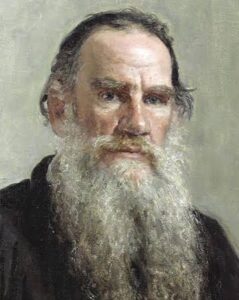
One of the greatest and most influential writers of all time, Leo Tolstoy, was also born on August 28, seventy-nine years after Goethe. His most famous novels are War and Peace and Anna Karenina, but he wrote many other novels and novellas and 56 short stories. He wrote; I think…if it is true that there are as many minds as there are heads, then there are as many kinds of love as there are hearts. And: What counts in a happy marriage is not so much how compatible you are, but how you deal with incompatibility. Tolstoy’s long marriage was famously unhappy. After bearing him 13 children, managing their estate and transcribing and editing his manuscript for War and Peace, his wife Sophia Tolstoy objected when he decided to will their estate to the local peasants. He left her at age 82.
Mary Wollstonecraft Shelley was born on August 30th, 1797. Her mother was a philosopher and well-known advocate for women’s rights. Mary is known for her iconic novel, Frankenstein, and her marriage to poet Percy Bysshe Shelley.
Kurt Vonnegut said this of the writer William Saroyan: …the first and still the greatest of all American minimalists. Saroyan was born on August 31st, 1908. He wrote: In the time of your life, live—so that in that wonderous time you shall not add to the misery and sorrow of the world, but shall smile to the infinite delight and mystery of it.
And with that, I wish you a happy August.