
July takes its name from Julius Caesar, a great general, statesman and eventual “dictator for life.” That title didn’t sit right with the Roman senate, who feared he might make himself king. In less than a year he was assassinated. One of Julius’s many reforms was the Julian calendar which was adopted in 45 BCE and used in most of the Western World for 1600 years.
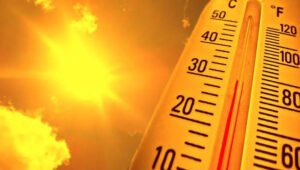
In the Gaelic tradition, July is called the yellow month. For most of us in North America, the hot and humid Dog Days extend from July 3rd all the way to August 11th. They were named for the dawn rising of Sirius, the Dog Star, the brightest star in our heavens after our sun. Sirius stems from the Greek “seirios,” which means “scorching.” The ancient Romans and Greeks believed that it was the combined heat of Sirius and the sun that produced the sweltering weather causing times of drought, violence and bad luck. In these days of climate change, it’s prime season for wildfire, which has burned thousands of acres of forest in the last decade.
For sky watchers, the planet Venus remains prominent in July’s evening sky. Jupiter can still be seen close to Venus in early July before it drops below the horizon. A conjunction of Mars and Uranus can be seen on July 4. For night owls, Neptune appears at midnight. And for the insomniacs and baristas, Saturn rises at 4 am. The new moon rises on July 14. The full moon on July 30 is called the Hay Moon.

We celebrate our 250th anniversary as a nation on July 4. A holiday hated by dog lovers and folks with PTSD. This year is particularly fraught because of the heated dispute about what kind of a nation we want to be.
uly 14 is Bastille Day in France celebrating the storming of the Bastille prison in 1789.
July 20 is Moon Day, the anniversary of the moon landing in 1969. I kissed my first boyfriend on that date.
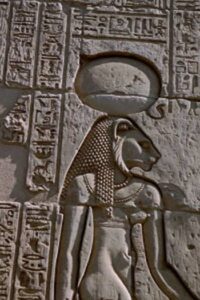
Sekhmet, the lion-headed goddess of ancient Egypt, roamed the earth during the hot days of July. Her breath was the hot desert wind, bringing plague. One story tells about the time Sekhmet was sent to earth by her father, Ra, the sun god, to destroy the mortals who had not offered him sufficient sacrifice. Once the slaughter started, Sekhmet was filled with bloodlust and killed men, women and children, nearly annihilating the population. She was so fierce and bloodthirsty that the gods were afraid she would kill all of humanity.
Her father joined the other gods and poured out a lake of beer and dyed it with red ochre. Mistaking it for blood, Sekhmet drank and drank until she was far too drunk to continue killing. Hungover, she returned quietly to Ra and the rest of humanity was saved.
As we move to a different pantheon, July 15th is the feast day of St. Swithin’s. According to British weather lore, if it rains on the 15th, we’ll enjoy forty days of wet weather.
St. Swithin’s Day, if thou dost rain
Full forty days it will remain.
St. Swithin’s Day, if thou be fair
For forty days, twill rain no mair.
St. Swithin was a 9th century champion of the poor and a beloved bishop of Winchester. On his deathbed, he requested that his body be buried in the common churchyard beneath the feet of the passers-by and rain from the eaves. His grave was the site for so many miracles that the monks of Winchester exhumed his remains and buried them in a crypt within the cathedral. The saint was unhappy at the change of resting place. He wept for forty days and forty nights. The sodden monks returned St. Swithin to his former grave.
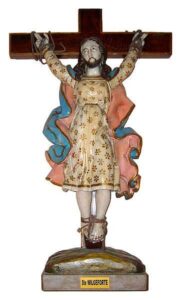
July 20th celebrates one of my favorites, the 14th Century St. Wilgefortis, or St. Uncumber as she is known by her followers. Her father promised her in marriage to the king of Sicily, and no amount of pleading would change his mind. The night before the wedding, Wilgefortis prayed to grow so ugly that the king would reject her. The next morning, she had grown a luxuriant mustache and beard. Her father was so furious he crucified her on the spot.
Wilgefortis promised her mourners that anyone who prayed to her would be free of the encumbrance of men. On July 20, a woman unhappy in marriage can bring oats to her shrine to feed the horse that will carry her husband away.
The feast day of one of the more controversial saints, Mary Magdalene, falls on July 22. As Jesus’s ‘Apostle to the Apostles,” she is thought to have written her own gospels. Apparently, Peter found Mary’s insights objectionable because she was a woman and therefore, a lesser human. Somewhere in time, she became “the penitent whore.” And she still remains the patron saint of sex workers.
The feast day of St Christopher, patron saint of travelers, falls on July 25.
In the literary firmament, we have William Strunk Jr., born on July 1, and co-author of Elements of Style. He warns us: Never call a stomach a tummy without good reason.
Franz Kafka, whose novels and stories blended realism with a disturbing dreamscape was born July 3. He’s best known for The Metamorphosis. He gave this advice to writers: Don’t bend; don’t water it down; don’t try to make it logical; don’t edit your own soul according to the fashion. Rather, follow your most intense obsessions mercilessly.
Nathaniel Hawthorne was born on Independence Day, most known by school children for The Scarlett Letter.
Robert Heinlein, Stranger in a Strange Land, was born on July 7th.
Both born on July 10th: Alice Munro won the Nobel Prize for Literature,;Marcel Proust did not.
Munro said: There is a limit to the amount of misery you will put up with for love, just as there is a limit to the amount of mess you can stand around the house. You can’t know the limit beforehand, but you will know when you’ve reached it. Proust said: Every reader as he reads, is actually the reader of himself. The writer’s work is only a kind of optical instrument he provides the reader so he can discern what he might never have seen for himself without this book. The reader recognizes in himself, of what the book says is proof of the book’s truth.
Born on July 11th, E.B. White is the co-author, along with William Strunk, of The Elements of Style, but he’s best known for Charlotte’s Web. He wrote: I would feel more optimistic about a bright future for man if he spent less time proving that he can outwit Nature and more time tasting her sweetness and respecting her seniority. Jhumpa Lahiri, Interpreter of Maladies, shares White’s birthday.
The brilliant poet Pablo Neruda shares his July 12th birthday with Henry David Thoreau, whose retreat from the world at Walden Pond was a half-mile from the road to town. His mother often brought him food.
Iconoclast Hunter S Thompson was born on July 18th.
Ernest Hemingway was born on July 21st. His minimalist style changed the way we write prose. He wrote: The world breaks everyone, and afterward, many are strong at the broken places.

But then there’s the florid, hilarious prose of Tom Robbins, Jitterbug Perfume, who was born on July 22nd and died this year at the ripe age of 92. He wrote: I don’t want salvation, I want life, all of life, the miserable as well as the superb.
Master of simile Raymond Chandler was born on July 23rd. Here’s an example: She looked playful and eager, but not quite sure of herself, like a new kitten in a house where they don’t care much about kittens.

We end the month on the windy moors of Yorkshire with Emily Bronte. Author of the haunting Wuthering Heights, her birthday is July 30. Her character, Catherine Earnshaw said: I wish I were a girl again, half savage and hardy, and free.