
Well-apparel’d April on the heel
Of limping winter treads
–Shakespeare
April comes from the Latin aperire—to open. This time of year the earth has thawed and opens up to seeds once again. April is all about sex and fertility. But first, we’ll take a look at Passover and Easter Week in the Jewish and Christian faiths.
This year Passover begins at sundown on April 1st in the Hebrew faith. In the Old Testament, Yahweh came to Moses and told him that the Egyptians would be visited by ten plagues unless they released the enslaved Hebrews. The tenth and most devastating plague was death to the firstborn of every human and every animal. To avoid this fate, the Hebrews were instructed to sacrifice a lamb at twilight and mark the gateposts and over the door with blood from the slaughtered lamb to signal the Angel of Death to pass over that household. The following morning, the grief-stricken pharaoh freed all his Hebrew slaves.
April 1st also falls in Holy Week in the Christian faith. It is called Spy Wednesday, the day that Judas Iscariot betrayed Jesus to his enemies for thirty pieces of silver. April 2nd is Maundy Thursday this year. Maundy is Latin for mandatum or commandment. Jesus gathered his disciples to celebrate the Passover, his Last Supper. He told them, I give you a new commandment that you love one another as I have loved you. Good Friday falls on April 3rd. It commemorates Christ’s death on the cross, a solemn and ill-omened day. In British folklore, a kindly woman was said to have offered Jesus a loaf of bread on his way to Calvary, and therefore no bread or buns made on Good Friday will ever go moldy. If baked on Good Friday, hot cross buns protect sailors from drowning and houses from fire. Good Friday is also a good day for planting cool weather vegetables as they will spring from the ground and flourish like Christ rising from the dead. Easter falls on April 5th this year, the first Sunday after the full moon following the spring equinox. It is the most important and holy day in the liturgical year for Christians. It celebrates Jesus Christ’s triumphant resurrection from the dead.
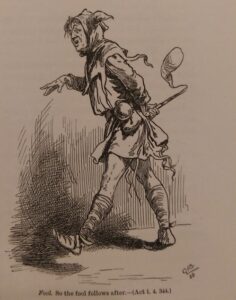
April 1st is April Fool’s Day when people play practical jokes on one another. Fools or jesters were well known throughout Europe, China, Persia and the Aztec empire. They served in the courts of kings and wealthy aristocrats or travelled with bands of performers telling stories and jokes, performing magic tricks and juggling. Shakespeare explored the many faces of the fool in his plays. In King Lear, the fool plays the role of truth-teller for the king. When Lear is deposed, the fool is his caretaker. The role of fool in Midsummer Night’s Dream has two faces: Puck, as fairy trickster, whose job is to amuse the fairy king; and Bottom, the simpleton and object of derision for the fairies, the royal court, and Shakespeare’s audience. Falstaff plays the part of fool for his beloved Prince Hal in Henry IV, part 1 and 2. Falstaff has a long list of shortcomings which he cheerfully admits to. He makes a case for living the debauched life, his one virtue is that he truly loves Hal.
Jan Kott in Shakespeare, Our Contemporary writes: The fool does not follow any ideology. He rejects all appearances of law, justice, moral order…He has no illusions and does not seek consolation in the existence of natural or supernatural order, which provides for the punishment of evil and the reward for good…The fool knows that the only true madness is to recognize the world as rational.
The word fool comes from the Latin follis meaning a pair of bellows or windbag. The Fool introduces the Major Arcana in the tarot deck, inviting the seeker to step into the world of the archetypal. He is the ancestor of the joker, often the wild card in card games.
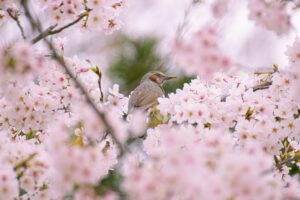
April’s full moon is called the Pink Moon because many of the quince, cherry, magnolia and redbud trees bloom during the month of April. The Pink Moon rises on April 1st this year—no fooling.
A magical Easter Bunny leaves candied eggs and sometimes Easter baskets filled with candy and chocolate bunnies for the children on Easter morning, April 5th. I’m not the only parent whose child caught wise about Santa Claus, but was shocked and saddened to hear that his/her parent was the Easter Bunny. The egg is an ancient symbol of creation. The belief that Earth was hatched from an egg is shared with the Celts, Greeks, Hindus, Siberians, Vietnamese, Chinese and Native Americans. Just as a chick emerges from its shell, so Christ emerged from his tomb on Easter morning in the Christian model.
On April 23rd, we celebrate St. George, the dragon-slayer, patron saint of Great Britain, Ukraine and Ethiopia.
April 24th is Saint Mark’s Eve. If you want to creep yourself out, go to a church porch at eleven at night and remain there for two hours. During that time phantoms of people who will die in the next year will pass by. If you see your double, it’s time to get your affairs in order.
April 30th is May Eve signaling the end of the winter half of the year in Northern Europe. It was the time to drive your herds to their summer pasture. Villagers lit huge bonfires. The smoke and ash from these fires had special protective powers. Young people often paired up as they searched the forest for flowers for the May Day festival the following morning. As a result, many children were conceived this night. As with Halloween (the return to the winter half of the year) the veil between the living and the dead, mortals and immortals was at its thinnest.

On that note we turn to famous writers born in April.
Milan Kundera, Czech author of The Unbearable Lightness of Being was born on April 1st, 1929.
On April 2, Giacomo Casanova was born. It’s no surprise that he wrote: Be the flame, not the moth. And I hate death; happy or miserable, life is the only blessing which man possesses, and those who do not love it are unworthy of it.
Poet and civil rights icon Maya Angelou was born on April 4th.
On April 7th the great Romantic poet, William Wordsworth was born.
Novelist Barbara Kingsolver, author of Animal Dreams, The Poisonwood Bible, Demon Copperfield and many other fine books celebrates her birthday on April 8th. She wrote in Animal Dreams, The very least you can do in life is figure out what you hope for. And the most you can do is live inside that hope. Not admire it from a distance, but live right in it under its roof.
Paul Theroux, writer of many travel books and novels, was born on April 10th, 1941 wrote: I think I understand passion. Love is something else.
Eudora Welty was born on April 13th, 1909. She gave this advice to writers: Write what you don’t know about what you know.
Born on April 15, Henry James is considered the father of the modern novel. His most famous novels are Portrait of a Lady, The Golden Bowl and the novella Turn of the Screw.
Irish J.M. Synge, most famous for his play, Playboy of the Western World, was born on April 16th. On a beautiful April day, think of Synge’s words: There’s the sound of one of them twittering yellow birds do be coming in the spring-time from beyond the sea, and there be a fine warmth now in the sun, and a sweetness in the air, the way it’ll be a grand thing to be sitting here quiet and easy smelling the things growing up, and budding from the earth.
On April 21st, 1838, the beloved Charlotte Bronte was born. She wrote about the interior life of women and is most famous for her novel Jane Eyre.
Vladimir Nabokov was born on April 22nd. He’s most famous for his novels Lolita and Pale Fire. He wrote: A masterpiece of fiction is an original world and as such is not likely to fit the world of the reader.
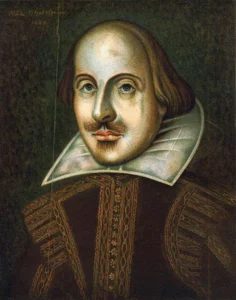
April 23, 1564, is the birthday of the god of literature, William Shakespeare. His wit, his verse and his portrayal of human nature is incomparable.
April 28th is the birthday of Harper Lee, author of To Kill a Mockingbird
April 30th is Annie Dillard’s birthday. Who would call a day spent reading a good day? But a life spent reading—that is a good life.
I’ll close the month of April with a verse by Shakespeare:
O how this spring of love resembleth
The uncertain glory of an April day,
Which now shows all the beauty of the sun,
And by and by a cloud takes all away.